Showing posts with label peanuts. Show all posts

Thursday, October 20, 2011

How Does Your Garden Grow?


     Years ago, I saw a poster of an aerial view of a farmer’s field where he had plowed the words “thank you.” It could be read only from the air. That farmer knew Whom to thank, and it wasn’t the Department of Agriculture. Horticultural images turn up a lot in the Bible, and as I garden, I think I start to understand them better. Back when most people were involved in farming, they must have understood things like the parables of Jesus better than we do today.
     Pastor Bill is walking us through the “parables of the Kingdom,” the stories Jesus told to give people an idea of how God operates in the world, for instance in Mark 4: “The kingdom of God is like a man who casts seeds upon the soil and goes to bed every night and gets up each day, and the seeds sprout up and grow—how, he himself does not know. The soil produces the plants by itself; first the blades, then the heads, then the mature grain in those heads. And when the crop is ready, he immediately puts in the sickle, because the harvest has come.”
     Have I mentioned how miraculous it seems that I can push a seed, a little round woody-looking thing, into the ground and a few days later find a seedling pushing up from the soil? There’s a funny little folk song that turns up sometimes in elementary school music programs. Versions vary, but here’s one:
Oats, peas, beans and barley grow,
Can you or I or anyone know
How oats, peas, beans and barley grow?

First the farmer sows his seed,
Then he stands and takes his ease,
Stamps his feet and claps his hand
And turns him round to view the land.
If the folk who first sang this weren’t thinking of the parable, then at least they had the same awareness. How and why things grow is mysterious. Once the farmer has prepared the field and planted the seeds, he can clap and stamp all he wants, but it has nothing to do with the growth. That happens automatically. (The phrase translated “by itself” is in the Greek automatos, Pastor Bill informed us.)
     So is Jesus just making a point about agriculture here? Hardly. He did start with “The kingdom of God is like…” He is growing a crop of subjects for His kingdom, people who will know Him and be happy about it. When the crop is mature, it’s time for the harvest, and in goes the sickle. I don’t have much experience with harvest, but I have dug up a few handfuls of peanuts from my miniature field. Most look good, but some are shriveled inside, or even empty. People are that way too. Here’s where it gets scary. Some are wheat; some are weeds that only look like wheat. (See the “wheat and tares” parable, Matthew 13: 24-30.) The good ones He keeps. The rest go into the fire. 

Firstfruits of my modest peanut harvest.
Speaking of peanuts...

Sunday, April 17, 2011

Poor Charles Darwin

     Soon as I started wresting out roots and weeds from my new peanut patch, what should pop into my head but the lyrics, “I was out choppin’ cotton, and my brother was bailin’ hay-ay-ay.” Over and over, that one line from—anybody remember?—“Ode to Billy Joe.” All about “the day Billy Joe McAllister jumped off the Tallahatchie Bridge.” Mm hmm, a real classic. Digging just a few yards from my air-conditioned suburban 4/2, I was hardly a redneck farm girl, but I felt a teeny-tiny bit of kinship. I was wearing a straw hat, anyway, and the band was sweaty.
     The first peanut patch is looking quite vibrant and productive, with a splash of astonishing beauty, ‘cause that’s how God rolls. The plants seem sturdy and businesslike, like Tolkienish dwarves, especially compared to the lacy tomatoes behind them. They are short and strong and do their main work underground. They also craft gorgeous, complex golden flowers, yellow with slender veins of orange, about half an inch wide. Like other tiny flowers I’ve discovered in my garden, they are shaped like orchids.
     Discovery, discovery, discovery, that’s gardening. I suppose farmers and other more experienced plant growers might pat me on the head and smile tolerantly, but I keep finding things to wonder at. Like those orchid-shaped flowers that you need a magnifying glass to discern. Or an odd little weed that belonged in an antique botanical sketchbook, bearing as it did tiny sprigs of round seed casings, articulated like pumpkins. The sprigs emerged from a slit in a flat green envelope that simply wasn’t roomy enough to produce them!
    I feel like Dr. Maturin in the Patrick O’Brian seafaring novels (Master and Commander, et al.) when I find one of these wonders. Just look how the baby figs pop out directly from the stems. How new pineapple plants show up in the wreckage of frozen parents. How the passionfruit vine, with its most splendid of purple, yellow and white flowers, climbs into the oak tree and drops fruit from the sky.
     “Poor Charles Darwin,” I think. He looked at such things, along with the lizards and snakes and squirrels and hawks and buzzards and ibises and mallards (all of which have turned up in our neighborhood if not our yard) and tried his best to explain them away. He couldn’t give God credit, so he made up a system of time and accident to explain eyes and ears, flowers and seeds, and color-changing lizards. I can’t not give God credit. The closer I look, the more marvelous the creation seems, and the more it seems He is standing right there saying, “Yes, I made this too.” The peanut is no accident. And neither am I. 
Peanut blossom, half inch wide in real life.

Impossible burst of pods
Passionfruit vine blooms twice a year

Saturday, March 26, 2011

Peanut Exegesis

 
     Last year, I dug out a nifty little bed for my specially-ordered, organic, super-duper, non-hybrid peanut seeds, George Washington Carver’s happy dream. I added some real soil to the gray sand and raked in the compost. Well, sort of compost. That would be another story. I fertilized, planted and watered and sat back to wait. And wait. Then I had four seedlings and a lot of little holes. Squirrels, adorable, furry balls of malicious evil, had made my sweat-earned plot their own smorgasbord. I called them rude names and ran for my roll of bird netting to cover the remainders. Their little stems unfolded happily, riffling leaves out like playing cards. They got about three inches tall, but not for long. In the next day or two, something snapped the stems of every one of them. I envisioned cackling rodents at midnight, saying “Ha, we’ll show her.” But maybe it was snails.

            So this year I bought a package of raw peanuts at the grocery store for a lot less money, let them dry out, and shelled them for seed. I gave the same dig-deep and compost treatment to a new bed. I just couldn’t use the old one again. The memories… Acting on trusty Internet guidance, I sprinkled the soil with cayenne pepper, and not just a few teaspoons either, nosirree.  Every time it rained, I added another stratum from the enormous warehouse-club jar, emptied one and started another. Rejoicing in the news that oil of peppermint makes tree-climbing vermin feel like they can’t breathe (Really, people, how did anyone find this out? “Here, little squirrel, sniff this cotton ball and tell me how you feel.”), I dripped the stuff around the edges of the patch. Well, two and a half cheers for the advice of Web denizens, because at this point I have a couple dozen energetic-looking peanut plants. My rejoicing is muted, given that this old world is still “subject to futility,” but my hope is rekindled.

The most splendid of the peanut plants.

I think I see purple, but it may be wishful thinking.

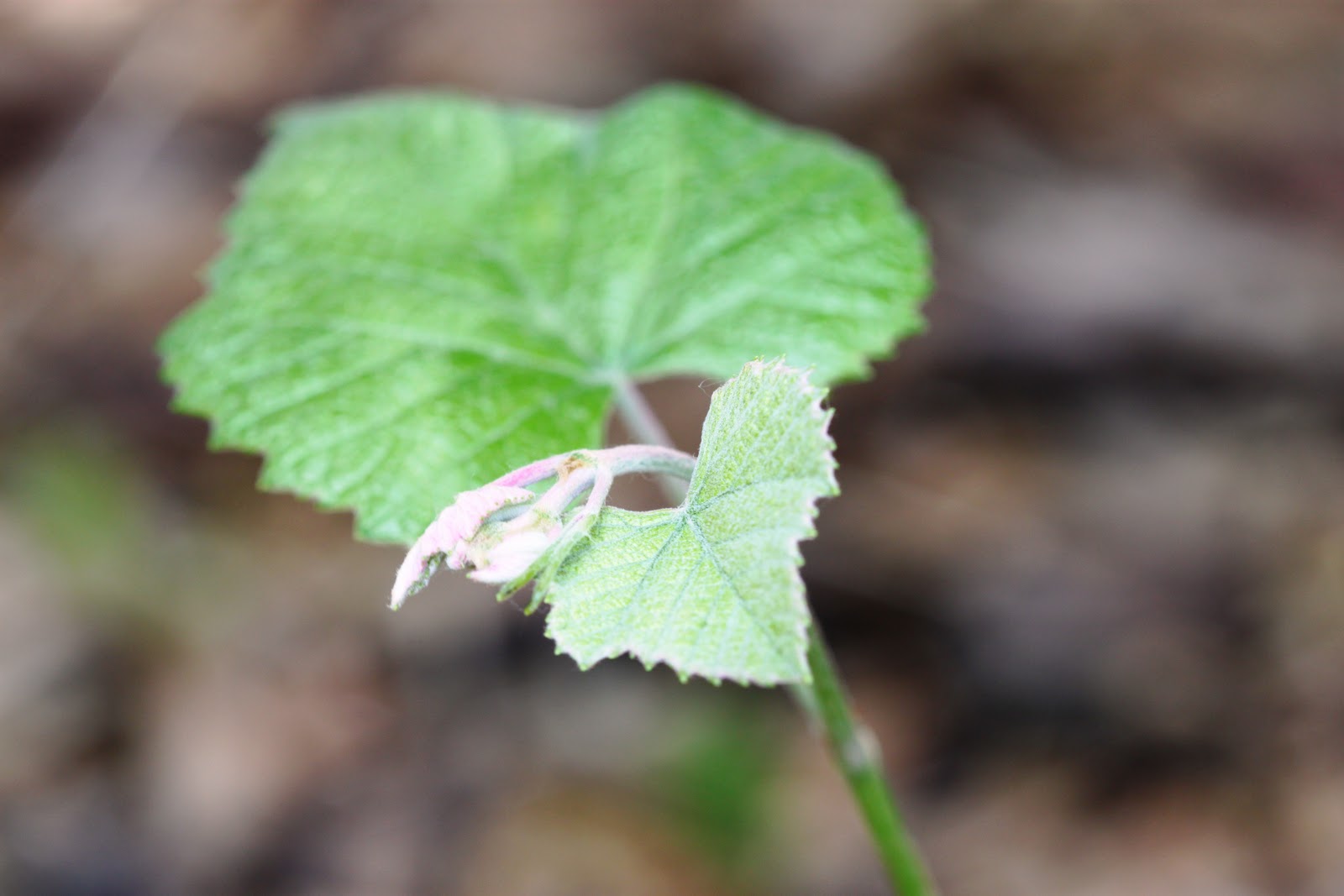
Grape tendril, or charismatic preacher?
New leaves of the grapevine are purplish-pink before they unfold.